Tuesday, February 17, 2009

Psych questions for Mod 24-26, 31

1. __ Cyrus falls down several times while trying to learn to dance. He has poor...?
2. __ Students do as the teacher does.
3. __ To solve a science question, students gather at a group to solve the problem.
4. __ In their psychology class, students are given pieces of information found in the text and are responsible for teaching them to their peers.
5. __ Suzy has difficulty keeping her hand out of the cookie jar even though she knows it will anger her mother.


a. cooperation
b. jigsaw
c. modeling
d. volition
e. self-efficacy

1-e; 2-c; 3-a; 4-b; 5-d

Teaching Reflection for Psych

I thought our presentation went fairly well. Students seemed interested and had fun with the improv idea. Most students interacted in the games and answered questions we had with good accuracy. I'm sure the food stimulus helped a little.
As far as what we could have done better, I believe a few things could have been worked on. Voice flux needed to be worked on to remove the monotone feel. More movement through space would have helped as well. Definitions could have been explained in a better manner to help students understand the differences between the subjects taught.

Thursday, February 12, 2009

Edu Psych Q's Mod 2-5

1. __ specialization of two hemispheres (sides) of the brain
2. __ support for learning and problem solving; helping that allows students to grow
3. __ assuming that others experience the world the way you do
4. __ arranging objects in a sequential order according to one aspect
5. __ fitting new information into existing schemes


a. scaffolding
b. seriation
c. assimilation
d. egocentric
e. lateralization

answers: 1 - e ; 2 - a ; 3 - d ; 4 - b ; 5 - c

Wednesday, February 11, 2009

Storyboard

This is a story about Victors Villainous Valentines. The storyboard is a short rendition of what I hope will be a fun story about a boy whose broken heart turns to a hatred for valentines day, but through love he finds his heart and romance. As the title suggests, the story will be told through alliteration to teach children a variety in ways they can write to tell a story.

TPACK integration:

Content: 5th Grade Core
Standard 1
Oral Language-Students develop language for the purpose of effectively communicating through listening, speaking, viewing, and presenting.
Objective 2
Develop language through viewing media and presenting.
a. Identify specific purpose(s) for viewing media (i.e., to identify main idea and details, gain information, distinguish between fiction/nonfiction, distinguish between fact/opinion, form an opinion, determine presentation’s accuracy/bias).
b. Use a variety of formats in presenting with various forms of media (e.g., pictures, posters, charts, ads, newspapers, graphs, videos, slide shows).
Standard 4
Phonics and Spelling-Students use phonics and other strategies to decode and spell unfamiliar words while reading and writing.
Objective 3
Spell words correctly.
a. Use knowledge of word families, patterns, syllabication, and common letter combinations to spell new words.

Hopefully the children will see the alliteration throughout my digital story. The title is an example: Victors Villainous Valentines, emphasizing the "v" sound.

Pedagogy: Children should find this visual example of alliteration as a fun type of expression. Through language, children can truly express themselves in a wide variety of ways, which will entertain and bless. Children should use motivation to envision a story and think of ways to use alliteration to convey a message. Children will also use group work skills as they collaborate with others on their projects.

Technological: Children will use various technologies for this assignment. They will hand-sketch their storyboards and use a scanner to place them in a computer. They will also use software to create and tell their stories. The software will be determined by the teacher and type of computer; apple computers will more than likely be equipped with imovie, while windows based pc's will use movie maker or photostory.


Wednesday, February 4, 2009

IP&T Questions for Mod 15-17

Which of the following is an example of Removal Punishment?
a) mandatory traffic school after speeding
b) no tv after hitting someone
c) detention after not turning in homework

Pavlov proved classical conditioning through:
a) viewing salivating dogs
b) teaching monkeys to pull levers
c) watching mice run through mazes

Which of the following is an example of Operant Conditioning?
a) a monkey who pulls a lever to release a favorite candybar
b) dogs who salivate when they hear the dinner bell
c) automatically folding your arms in church after an opening song

TPACK Questions Response (Science Lesson)

What is the content you’ll be using in your lesson?

The content I focused on in my science lesson from the Utah's state core curriculum was geared towards the 5th grade. Science standard two states that students will understand that volcanoes, earthquakes, uplift, weathering, and erosion reshape Earth's surface. I narrowed the focus from standard two to objective two which states that children will explain how volcanoes, earthquakes, and uplift affect Earth's surface; subsection a states that the children will also be able to identify specific geological features created by volcanoes, earthquakes, and uplift.

What is the pedagogy you’ll be using and why is it a good fit with the content?

There are lots of teaching methods involved in this lesson. Students will collaborate in groups to discover exciting places on earth. They will also use problem solving skills in determining the where and when of assignment; the tour requires that students choose dialog and a vision to implement their tour successfully.

What is the technology you’ll be using and why is it a good fit with the content and pedagogy?

The technology used in my science lesson was Google Earth 5.0. I love how detailed the maps are and how full of life the user created content can be. This software allows students to not only view volcanoes and their effects on surrounding areas (see Mt. St. Helens), which is part of standard two of the educational core in the state of Utah, but it also offers a plethora of data on various areas around the world. Students can click on items to view a range of pictures that contain data about the volcanoes and their surrounding areas. Google Earth also allows children to record a virtual tour that may be watched by fellow classmates. The volcanoes are chosen by the students themselves and therefore the information will be personal because they will have a sense of self involved.

Christopher Who?

For this portion of the Tech Savvy Teacher we will be exploring one of the millions of ways the new Google Earth 5.0 can be implemented into the classroom. This specific lesson is aimed at 5th grade and covers

Standard 2
Students will understand that volcanoes, earthquakes, uplift, weathering, and erosion reshape Earth's surface.

Objective 2 Explain how volcanoes, earthquakes, and uplift affect Earth’s surface.
a. Identify specific geological features created by volcanoes, earthquakes, and uplift.
b. Give examples of different landforms that are formed by volcanoes, earthquakes, and uplift (e.g., mountains, valleys, new lakes, canyons).
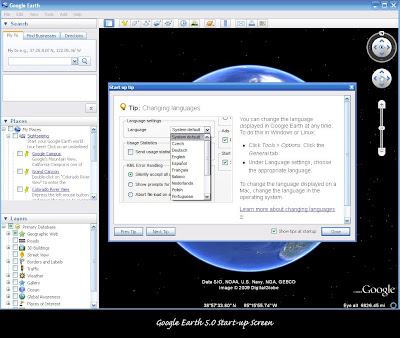


Using Google Earth 5.0 is a perfect way for students to explore volcanoes, their history, and their placements on the Earth (which happens for a reason!). Before starting the lesson, students should have basic knowledge on volcanoes: their types (cinder cone, strato, shield, etc), how they are formed, and how they have a tendency to form along plate boundaries. Once students have a basic understanding of volcanoes the fun can truly begin. Students should be paired into groups of two or three and asked to highlight two volcanoes from each of the three volcano types: cinder cones, stratovolcanoes, and shield volcanoes. This will allow children freedom to explore any volcano on Earth that fits one of the three types; this will also allow for variety in projects.
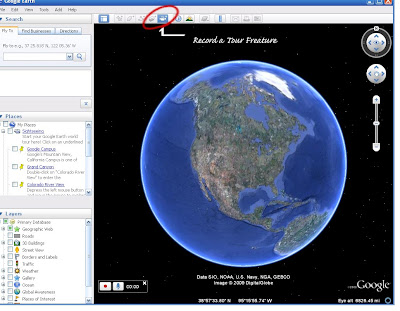


The purpose of using Google Earth for this assignment is the "Record a Tour" feature. This wonderful feature will allow your students to create a virtual tour and allow the other students to watch the tour at a later time. Before creating the actual tour, students should choose their volcanoes, the history of the volcanoes they chose, and any information they deem necessary to their tour experience. This is where imagination should be encouraged. Students may decide to do 'interviews' with the locals and ask them questions about the volcano, and/or have an interview with someone who witnessed an eruption of the specific volcano. Students may decide to describe the history of the people living in the area, the host country, etc.
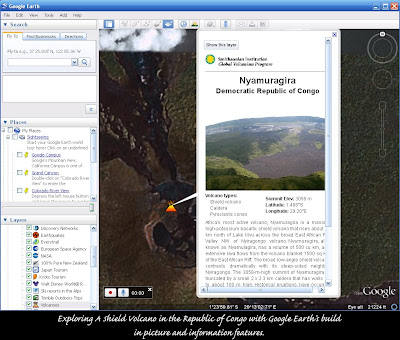


Now that information has been gathered, microphones connected, and voices warmed up, students should be ready to record. Students will begin by clicking the "Record a Tour" button and will then click on the microphone. This will begin recording the tour and will record anything they say and any places they go. It will record their zooms, tilts, rolls, etc and students should be mindful of this. It may be helpful for teachers to create their own example and briefly explore the buttons and mouse actions.
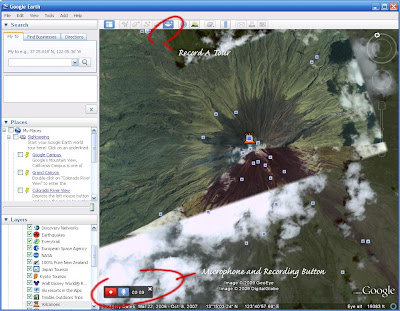


Once all students have recorded their tours, teachers may decide to show them to class. All tours can be found in the "Places" menu.


Hopefully, this lesson will create some excitement in the classroom by allowing students to use technology to explore the subject of volcanoes. Children should be encouraged to be creative and truly enjoy the experience.